From Bot’s Up? to the EduBot-a-thon
Using Custom ChatBot Design to Inspire Criticality, Collaboration, and Computation
By Jenia Marquez
Note: Quotes from interviews edited for length and clarity.
GO BACK TO ALL SPOTLIGHTS

Prof. Casandra Silva Sibilin is a Lecturer in Philosophy at York College, City University of New York (CUNY), specializing in philosophy of education and the role of generative AI in teaching and learning.
Prof. Sibilin co-founded Don’t AI Alone, a cross-campus community for inclusive, interdisciplinary dialogue across 25 CUNY campuses, and led the Education team for Building Bridges of Knowledge, a CUNY-wide fellowship supporting ethical and effective student AI use. Her work includes open educational resources that help educators and students design their own AI tools, including Student-Made Bots: An Educator’s Toolkit. Beyond CUNY, she leads the Custom Bots/GPTs subgroup within a global AI in Education community connected to the POD Network. She is currently writing a book on AI pedagogy through the lens of foundational thinkers in philosophy of education.
“In philosophy, and in the way I teach philosophy, of course critical thinking is really important. And I teach students, you can’t really understand an argument unless you know the counter-argument. What is the counter-claim, and what are the different perspectives on this issue…
…First of all, that critical stance, always asking questions, that’s the heart of philosophy, serves very well in this AI time. AI platforms and Chatbots have been designed to be very polished, and to sound impressive and even anthropomorphic, so we tend, on purpose, to just want to accept what they say. And I always want to teach students to question that and resist that pull. At the same time, I love the shared values of not just “about” technology, but also “with,” “through,” and “against.”
Prof. Sibilin’s “Why” for CITE
At its core, philosophy boils down to one primordial, yet often stymying, question: “Why?” From this elementary query to the Socratic method to advanced topics in educational philosophy, this inquisitive and critical mindset permeates every aspect of Prof. Silva Sibilin’s ethics and practice. So, when she attended her very first CITE webinar in 2023, she knew immediately that she fit right in. Her background and principles in philosophy segued perfectly into CITE’s values of working both with and against technology and critically evaluating tools and AI outputs, and she felt welcomed by the norms of collaboration, tinkering, and joyful computing. It is the combination and evolution of all of these values that ultimately shaped the three major iterations of her CITE teaching artifact, which has grown from a single assignment to a hack-a-thon-style competition with judges hailing from all across CUNY.
“From the start, I felt very welcome with the shared value of joyful learning and tinkering. Like that felt empowering from the start; even if we were learning something new, we were learning it together, and that was really important.”
Prof. Sibilin’s Context
Prof. Silva Sibilin teaches a mandatory course in the ethics of computing for all education majors, and, in the last few years, as we’ve all witnessed the rise of AI, she sought to pilot an assignment that would critically investigate the nature and uses of generative AI chatbots that rely on large language models. In her initial research and ideation, she combined basic tenets of philosophy, AI literacies, and play, in an assignment premise as outlined below:
- Computer Science: Prof. Silva Sibilin asks her students to engage in AI literacies such as prompting, by instructing a chatbot to take on a particular persona and an associated task to perform within specified parameters (i.e. assume the role of a French tutor, who will only communicate in French and utilize specific provided grammatical constructions). She asks them to look for patterns in the output as they engage the chatbot in performing that persona.
- Philosophy: She asks her TCs to investigate what it means to perform like Persona X, what relevant educational roles exist and could be filled, how they are distinct, and what is at the core of being a teacher. TCs then critically analyze how effectively, if at all, the chatbots assume the needs of these roles.
- Play: TCs engage in and prioritize imagination and tinkering through investigating existing chatbots and designing their own.
Prof. Sibilin’s Learning and Artifact Design Journey
Over the years, Prof. Silva Sibilin has deepened her exploration in these three areas by engaging in a multi-year revision process, during which she not only has adjusted the assignment to account for technological change, but also adapt to her students’ evolving ideologies around and comfort with AI.
First Iteration: Bot’s Up?
Combining the aforementioned tenets of computer science, philosophy, and play, in Fall 2023, Prof. Silva Sibilin piloted an activity she called Bot’s Up?, in which students responded to the following prompt:
Imagine that an AI Bot wants to be part of our class and your learning experience! Being a Bot and new to this experience, it is not quite sure how to be part of the class so, it will try out for a variety of roles. It will be up to you to evaluate how it does and what role, if any, you’d like it to play in education.
Students critiqued and investigated the bot’s performance in six possible roles, outlined below:
| How well does the AI Bot perform as each of these roles? | |
| Teacher | Consider experimenting with any of the activities a teacher might do, such as: ▪️ Teaching new material ▪️ Designing lesson plans ▪️ Designing quizzes or other assignments. |
| Tutor/Homework Assistant | Consider exploring various ways it might assist, such as: ▪️ Helping you understand a difficult passage from a reading ▪️ Designing practice quiz questions ▪️ Getting started with an outline or brainstorming for a paper ▪️ Providing feedback. |
| Student Peer | Consider how it could contribute to class discussions and activities. |
| Philosopher | Consider getting the Bot to act as a philosopher and using its capabilities to go deeper with a philosophical issue or technique, such as the Socratic Method! |
| Educational Reformer | Does it have good ideas on how to make education better, at any level? |
| Motivational Coach | Consider how/if it could serve as a personal coach to help you achieve success in college and beyond? |
Overall, students critiqued the bots’ performance harshly and underscored the need to retain human presence in these roles – exactly the outcome that Prof. Silva Sibilin had been anticipating. While they acknowledged the bots’ ability to provide satisfying quantities of information (including ideas, strategies, activities, and lesson plans tailored to students’ prompts), they encountered an inability to provide deeper analysis, offer reliable resources, and tackle controversial and complex issues. After the semester concluded, Prof. Silva Sibilin began wondering: if given the opportunity, how would students, as chatbot developers, engage with or circumvent these issues?
Second Iteration: Custom ChatBots
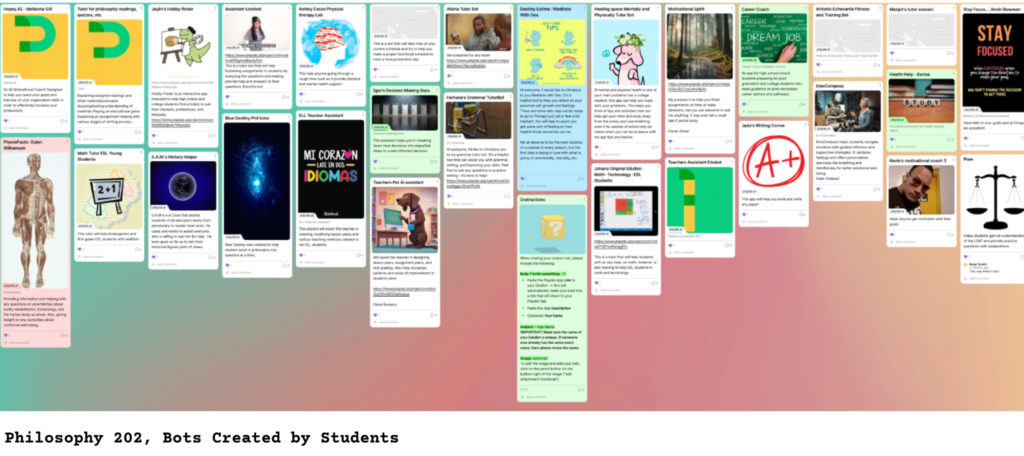
From Spring 2024 – Fall 2024, Prof. Silva Sibilin piloted a second version of the artifact, which centered teacher candidates not only as evaluators, but as creators of custom AI ChatBots. They then completed the same evaluations as in the first iteration, but for four roles: Educational Reformer, Motivational Coach, Teacher’s Assistant, and Tutor.
In this assignment:
- Students develop skills (logic, computational thinking, critical thinking) that are also useful for interacting with generative AI platforms.
- Students gain in-demand generative AI career skills.
- Students are empowered to build their own bots on open-source, free platforms rather than relying solely on pre-trained bots and/or commercial platforms.
- Students formulate their own judgments about the use of generative AI in education.
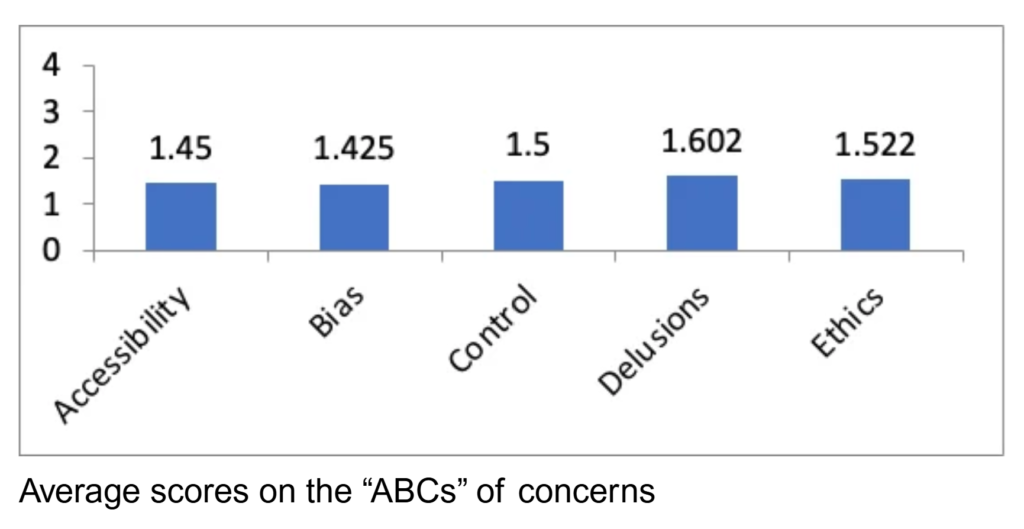
In addition to evaluating the bots along persona-based criteria, they also scored them using the “ABCs” of concerns, as seen below:
Third Iteration: EduBot Expo and EduBot-a-thon
For the most recent iteration of this assignment, taught from Spring 2025 through Fall 2025, Prof. Silva Sibilin revised the artifact to maintain the learning objectives from the second iteration, but also inspire collaboration among students, align with departmental efforts to create and promote ePortfolios, and correspond with Fink’s Taxonomy of Significant Learning, an external pedagogical framework.
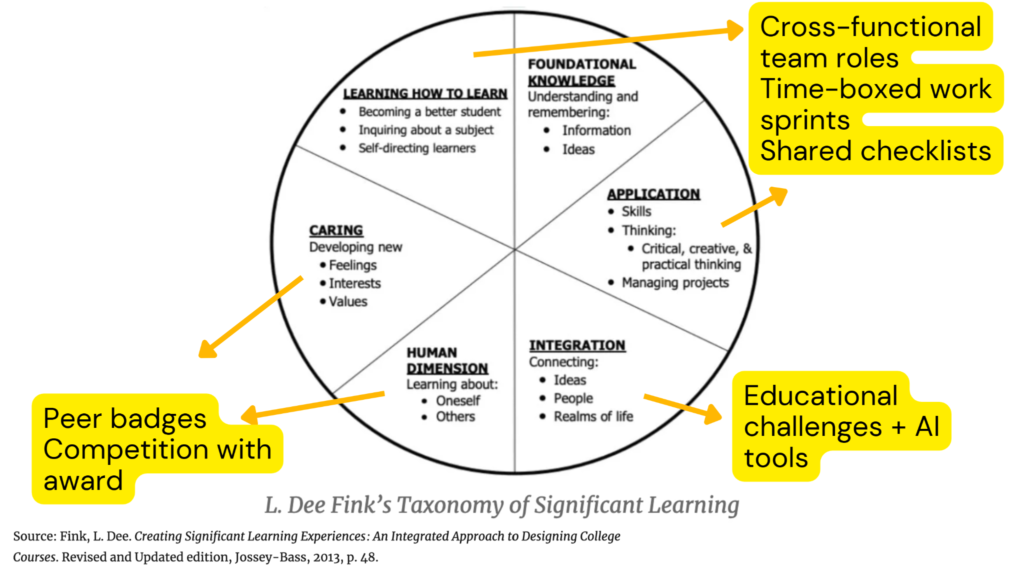
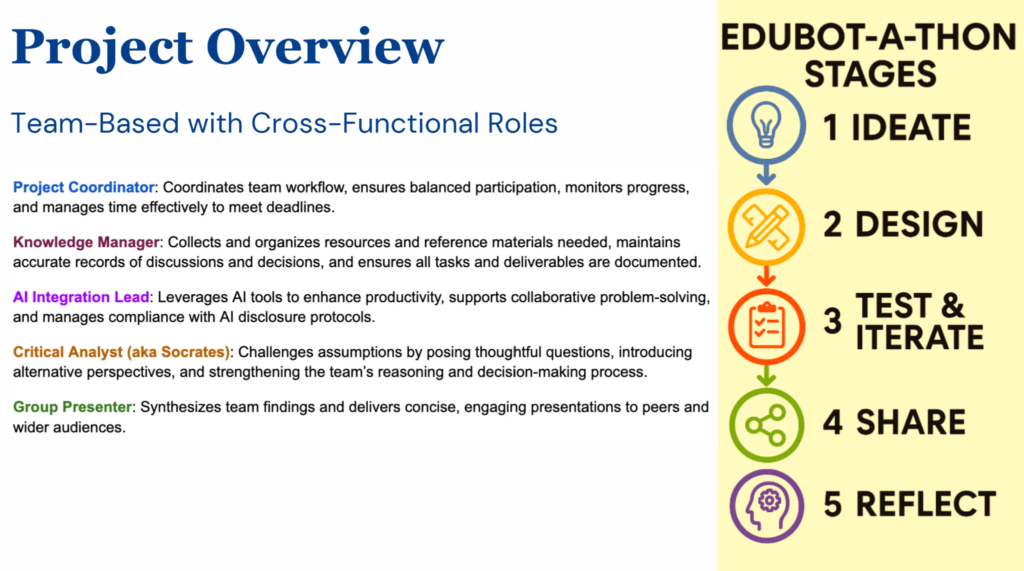
In this version, students were split into teams, each assuming one of five specific roles, as detailed below. Each team then created a custom ChatBot, as in the second iteration of this assignment, which they presented and competed at an “EduBot-a-thon,” a hack-a-thon-style competition with judges from across CUNY campuses. Each bot was evaluated along three criteria: originality, approachability, and effectiveness. Not only did students gain the critical benefits of the assignments, but they also generated a concrete, and possibly award-winning, deliverable that they could include in their departmental ePortfolios.
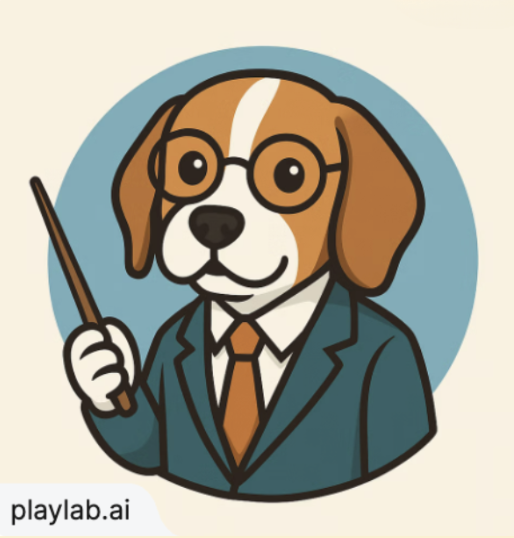
Explore the winning bot!
Beagle Bot: A tool to help create lesson plans with students and strengthen lectures.
Student Reactions
Each semester that she piloted her artifact, Prof. Silva Sibilin was thrilled to see that her students were not only coming away with her intended conclusions, but also embracing and absorbing the joy of “play” and collaboration that had both inspired her artifact and drawn her to CITE. Consistently, students harshly evaluated the Chatbots along ethical criteria and deemed them poor replacements for human counterparts, but carefully identified areas and ways in which they could potentially be redesigned and applied effectively. Even as they developed a critical and analytic mindset, the students never forgot their roles as peers, and more importantly, friends – they evaluated student-created bots more generously, and working in groups fostered a spirit of collaboration, tinkering, and creativity.
“Students really flourished when given autonomy and freedom, particularly in building their own bots. I always knew that group activities were important, but seeing how it was when they were building something together has been one of the biggest learning experiences for me.”
Although she has already revised her assignment thrice, Prof. Silva Sibilin’s work is not done. Each time she taught the assignment, she encountered an unexpected hurdle: increasing numbers of students with major ethical concerns about using AI in the first place. Their reluctance stemmed along multiple axes, including environmental harm, the realities and inequities of which populations are most affected by said environmental effects globally and locally, nefarious cognitive impacts, and automation and human replacement. In response to these growing concerns, she offered an unplugged version of the assignment for interested students, which she is currently developing further. In this version, the students still engage in the same philosophical and computational thinking without designing custom chatbots.
“It’s been a bit of a challenge, in the sense that when we started just some months ago, I hadn’t planned for that option. But now I am, and I’m very grateful to students for being so open about this resistance because in the end, the learning is, I believe, greater. We’re having these rich discussions about why they don’t want to directly work with an AI tool. And since it is in teams, there are still other teams that are building, so in the shareouts, we hear from all of the teams’ experiences.”
Parting Advice from Prof. Sibilin
Prof. Silva Sibilin’s advice to educators teaching and encountering various stances concerning AI? Lead with curiosity, meet your students where they are, espouse student input, and embrace the unknown!
“Start with curiosity, not assumptions. If you see the media coverage, a lot of what you hear is about cheating, or that students are using AI all the time, and a lot of it may not be true. Besides having students of many different stances with AI, I have also seen many students who haven’t really interacted with it and have very little experience. So don’t make assumptions about if and how your students are using AI – get to know them
A general pedagogical tool is to start with what students know, and get to know their knowledge base and experience before beginning your own materials – the same applies with AI, maybe more than ever. Learning where they’re coming from can be intimidating, and there might be some tools that you’ve never heard about, but it is a way to show students that you’re learning too. You have expertise and things you want to teach them, but at the same time, everyone can learn together.”
Links & Resources
- Prof. Silva Sibilin’s Linktree
- Canva presentation outlining the growth of the artifact
- Fink’s Taxonomy of Significant Learning

